Welcome, dear reader.
My name is Brent Hayhurst. I'm a singer-songwriter, carpenter, support worker and music mentor based in Daylesford, Victoria.
If you asked me how I ended up in this beautiful country town about an hour and a half from Melbourne — surrounded by forests, nature, waterfalls, great food, local produce, and of course so many beautiful people — I wouldn't know where to start. I wouldn't know how to tell you properly.
So let's rewind it back.
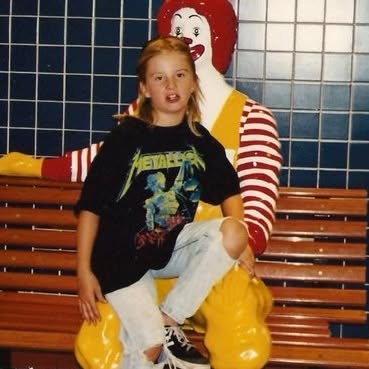
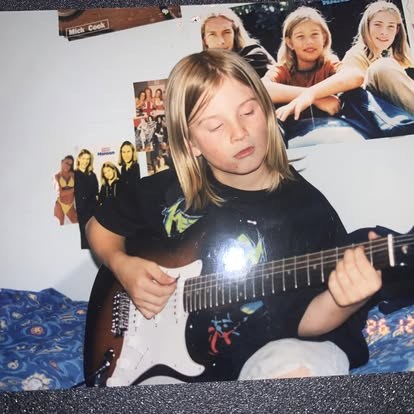
Since I can remember, I've been absolutely obsessed with music.
Some of my earliest memories are playing CDs and records on my mum's stereo, with my ears pressed right up to the speakers, listening to albums like Queen's Greatest Hits, Billy Joel, Elton John's Goodbye Yellow Brick Road, INXS, and of course — how could I forget — the soundtrack for Priscilla, Queen of the Desert.
An absolute banger.
I mostly had access to my mum's music because, unfortunately or fortunately depending on how you look at it, my father left the home when I was fourteen months old.
I was raised by the most incredible single mother who, though she didn't finish high school herself and we didn't have much, worked her arse off with such grace and love. She sacrificed everything for me and my brother, and shared everything she had with the many people who came through our door.
I'm still coming to terms with the impact that being raised by such an incredible woman has had on me, and I'll never take that for granted.
When I was around ten, my sixteen-year-old neighbour Deanna — bless her — became like a surrogate older sister to me. She came from quite a rough home herself, and my mum took her in in a lot of ways.
Deanna would look after us while Mum and her three best friends, who were also single mothers, went out for a night out. She would also occasionally take us to parties in garages or at public ovals, where I was around older sixteen-year-olds from the tail end of the grunge generation: smoking, drinking, playing pool in smoky garages, ripping cones and showing me bands like Metallica, Nirvana and Pearl Jam.
I became completely obsessed with what I was hearing.
I grew my hair out long, ripped my jeans, started wearing Metallica t-shirts, and gave the devil horns to anyone who would look my way.
One day they sat me down in front of the speakers and played Metallica's "Sad But True."
I literally remember the sensation of my head exploding and my mind melting.
That was it.
I was hooked.
I wanted a guitar.
My parents, who were already separated at the time, gave me the most incredible gift for my tenth birthday: a Squier electric guitar and a little 10-watt amp package.
My father, who we still saw every second weekend, was a beautiful man, though he had his challenges for sure. He passed away from a stroke at forty-seven years old in some pretty tragic circumstances.
My brother — a beautiful, sweet and talented individual — was already struggling with substance abuse and, let's say, a lack of long-term decision-making. In an already unstable household, that really tested us for many, many years.
So I was initiated quite early into being something like the man of the house, with a lot of emotional responsibility placed too early on the shoulders of somebody who did not have the skills or capacity to hold it in a way that would have helped.
We did our best.
Music became a very special place just for me.
A place I could enter.
A place I could express myself.
A place I could write through my feelings.
It became an incredibly important coping mechanism — but more than that, it became a way of sorting through the raw data of what was happening around me and turning it into something that felt meaningful.
But I never truly thought I could do anything with it or get anywhere with it.
Even though my first ever solo gig, when I was eighteen — not forgetting my high school band, The Retro Bogans, absolute legends — was a battle of the bands where I sold something like 135 tickets myself in the lead-up to the show, playing original songs on an acoustic guitar.
It was in a tiny little Irish pub in Ferntree Gully, Victoria, and there were people spilling out into the street.
I'll never forget the sound of the applause after each song. It was deafening. So many faces of people I loved in the audience — people from different years of high school, older boys, friends, parents, bosses.
And yet I still didn't believe in myself.
I was so incredibly tough on myself after gigs that it became a bit of a running joke with my friends. After I got off stage, they almost couldn't talk to me because I'd be focusing so heavily on the mistakes I'd made and thinking I'd done terribly.
It's a far cry from where I am now, although the challenge of believing in myself has, for sure, been the biggest mountain I've had to climb.
The view is starting to look quite nice.
"The challenge of believing in myself has, for sure, been the biggest mountain I've had to climb. The view is starting to look quite nice."
That's a lot of preamble. My point is: I've been obsessed with music my whole life. I've made music, worked in music, and worked in just about every aspect of the music industry.
After spending a few years doing carpentry, I left the apprenticeship and pursued music at twenty-two. I started a Bachelor of Music, and after two years switched into a Bachelor of Music Industry, majoring in artist management and songwriting.
From there, I worked all over the place.
What started as writing gig and festival reviews for Beat Magazine, and an internship with Mixdown Magazine in Melbourne, turned into becoming editorial coordinator at Mixdown, then artist management, publicity, booking shows, marketing, shooting and editing content, radio plugging for community radio and Triple J, and supporting local and nationally touring Australian artists.
Eventually, when the bands broke up, the burnout wasn't just from music itself. It was from the administrative cost of throwing myself into every single project so deeply that it had gone past breaking point.
So I threw the industry, and the industry things, away.
And I picked up two things:
A hammer.
And my guitar.
Back to the work.
Back to the writing.
That became the Tapestry EP.
And that EP sent me on an absolute fucking journey. An adventure of the highest order.
Five years. Probably about fifty grand. Recording and working across multiple countries. Demoing in Nashville. Recording at Rockfield Studios in the UK, where Queen and Oasis and a bunch of other legends had been before me. Recording vocals at The Avery Studio in Melbourne. Producer Jonathan Dreyfus tracking strings in Berlin. Launches in iconic Melbourne rooms like The Evelyn and The Toff, full to the walls with friends and family.
And a lot of the same people who were at that first gig in the little Irish pub in Ferntree Gully were still there, supporting me sincerely and wonderfully.
Did I believe it yet?
Almost.
Maybe not quite.
Who knows.
To the outside world, it might have looked like I'd taken a million detours: the music industry detour, the odd jobs detour, the Uber-driving-on-weekends detour, furniture removals, labouring, carpentry, whatever else I had to do to keep going.
But whether I realised it or not, I think I was gathering what I needed to make this music, and to gather the stories that would make it important — at least to me.
Working my arse off as a carpenter by day, often ten-plus-hour days, then funnelling basically everything I had into the art.
Paying off multiple credit cards. Putting myself into debt for film clips, tours, launch shows and recordings.
And I wouldn't take it back.
I really paid for an education. That's how I see it now.
To this point, I've never done a crowdfunding campaign. I've never really sold my music, except CDs and vinyl at launch gigs. I spent years making a record that was life-changing for many of the people involved.
It was beautiful.
It was difficult.
It was expensive.
It put me into debt multiple times.
And by the time the Tapestry EP finally came out, I had absolutely nothing left in the tank.
I uploaded it to Spotify and the usual places, and then I fell to the ground.
I don't think I promoted a single thing after the post I made thanking everyone for coming to the launch. I didn't send it to radio. I didn't make a proper run of social media posts. I didn't do paid marketing. I didn't do any of the things I had told many artists I'd worked with to do.
The music had nearly killed me, and then I just quietly put it on the internet and disappeared.
And that, in a nutshell, is part of why this website exists.
The current state of the way artists exist in the world is completely absurd. Not only are we supposed to make incredible art, we're also supposed to look amazing, be videographers, understand lighting, marketing, budgeting, touring, self-promotion, social media, algorithms, paid ads, content strategy, analytics, and whatever new little hell portal has opened this week.
And all of those things take us away from actually creating art.
That has definitely been the case for me.
I'm now working on my debut album after over twenty years of writing songs, producing music for other artists, mentoring young artists, managing artists, and doing a lot of things for other people.
Now I'm turning my attention to getting my music out there.
The new album.
The Tapestry EP.
Not just the songs themselves, but all the threads of story that bring them to life.
This is a place where I can showcase my art, my work, my story, and all the strange and wonderful evidence that comes with it — free from vanity metrics, likes, play counts, and whatever else we're supposed to measure ourselves by.
This is a place for me.
And for you.
Hopefully, it brings you into the story in a more human way.
Hopefully, you like the music.
Hopefully, you see yourself in pieces of this place.
Hopefully, it helps you think a little bit about what it's like to dedicate your life to art and continue creating through all of the uncertainty.
I'm now at a place where I've put the hammer down, at least for now, and I'm working with disadvantaged, at-risk and neurodiverse young men as a music mentor in Daylesford.
And all of these skills and experiences I've had are actually worth a lot.
So I owe it to myself, to the people around me, to the young guys I work with, and most importantly to my family and closest friends, to continue the train of doing things my way.
Uniquely.
Often slowly.
But always with the intention of sharing the most authentic, vulnerable expressions of who I am, in the hope that others might resonate.
So please, take a look around.
Make yourself comfortable.
And don't be a stranger.
Brenty